Tag: writing

  • Why Some Work Feels Premium—and Some Doesn’t

    Why Some Work Feels Premium—and Some Doesn’t

    “Hey, that’s a really nice outfit,” I told a friend when we met for dinner. She smiled and said it was from a platform that sold handcrafted, sustainably made clothing. Curious, I looked it up later—the outfit cost ₹6,500. I didn’t flinch. If anything, my admiration for the brand grew.

    Earlier that same day, I had ordered groceries through a quick commerce app. When prompted to tip the delivery partner, I declined. An hour later, I ordered handcrafted décor for my home and once again paid a visible premium, without hesitation.

    The contrast bothered me. It forced me to confront a quiet hypocrisy in how I—and many of us—decide what labour is worth.

    That discomfort showed up publicly on New Year’s Eve, when the founder of a large Indian quick commerce company (its name rhymes with Tomato) posted a series of tweets defending the gig economy. He argued that gig work provided livelihoods to many unemployed, unskilled Indians and implied that rewarding gig workers through tips was the customer’s responsibility, not the company’s. This came on the same day gig workers had tried, unsuccessfully, to strike for better pay and working conditions.

    The reactions were polarised. Some praised the founder for being honest. Others felt he was deflecting blame by moving responsibility away from platform economics and placing it on individual consumers.

    All of this led me to a simple question: why are we comfortable paying a premium for handcrafted or customised products, but hesitant to extend the same generosity to gig workers—whose effort is often greater and far more visible?

    Part of the answer lies in how we think about different kinds of work.

    Handcrafted products aren’t just seen as skill-heavy. They’re seen as intentional. Someone made a choice, added a personal touch, and left behind a sense of authorship. Branding, storytelling, and the language of craft make that technique visible.

    Gig work, on the other hand, is seen as task execution. Even when it involves navigating traffic, rain, unsafe roads, and restrictive housing rules, the work is framed as operational rather than creative. The bias is subtle but real: we reward visible agency more than raw effort.

    This isn’t because we don’t notice how hard gig workers work. We do. The delivery rider in the rain is right in front of us. What reduces the perceived value is repetition. When effort is repeated every day, it becomes routine. What is routine, becomes expected. And what is expected struggles to command a premium.

    Handcrafted labour escapes this because it is framed as exceptional, not routine. Its effort is not just visible—it is presented as scarce.

    Behavioural psychology explains part of why we hesitate to tip, but economics matters just as much.

    Paying more for a handcrafted product feels like a clean transaction. Tipping, however, carries discomfort. It reminds us of inequality. It forces us to judge who deserves what. It blurs the line between generosity and obligation.

    Tipping can feel like a small attempt to fix a broken system—one we didn’t create, but are being asked to compensate for. Buying a handcrafted product, in contrast, allows us to feel ethical without feeling responsible.

    One tweet from the quick commerce founder added another layer to the debate. He shared a breakdown of a gig worker’s potential daily earnings, suggesting that their monthly income could match that of an entry-level employee in an Indian IT services firm. Critics of the strike jumped on this, asking why gig workers didn’t simply find other jobs if the work was so demanding.

    The comparison is revealing.

    Having been a “veteran” of the IT services industry myself (a full 12 months), the similarities stand out. Entry-level IT services roles and gig work are both labour-intensive, repetitive, and underpaid. The work is process-driven, standardised, and built for scale. Individual ownership is low. Replaceability is high.

    In both cases, repetition devalues labour faster than effort can redeem it.

    The low pay here isn’t about low skill. It’s about low pricing power. Pricing power sits with platforms and clients, not with workers. Scale benefits companies far more than individuals.

    That said, IT services employees do have one advantage that gig workers don’t: optionality. Over time, some can move up—through career ladders, skill-building, overseas roles, or better pay. Today’s low wage is often framed as the entry fee for future rewards.

    But this promise isn’t evenly distributed, and it doesn’t justify being underpaid today. Much like the “flexibility” offered to gig workers instead of stable income, future mobility acts as a psychological cushion—it keeps the system running without fixing its flaws.

    Another claim made by the founder was that gig work offers opportunities to uneducated citizens. This brings us to a deeper issue: class and access.

    Education and social capital don’t just build skills; they signal legitimacy. Many gig workers and entry-level IT employees come from backgrounds that limit access to elite credentials, strong networks, and the ability to shape narratives. Their work enters the market already discounted.

    When handcrafted work is backed by education, branding, or cultural capital, the same effort is reframed as artisanal—and therefore premium-worthy. The gap isn’t about capability. It’s about who gets to define value, and how convincingly.

    Writers like Vivek Kaul have made this point clearly, especially in his writing on the gig economy for Newslaundry, where he shows how risk and instability are pushed onto workers in the name of opportunity.

    The gig economy, like the Indian IT services industry, has brought income to millions of households. It has raised convenience to new levels and driven consumption. These sectors matter.

    But acknowledging their impact doesn’t mean ignoring their inequalities.

    Mass employment cannot be used to justify poor working conditions, low wages, or shifting moral responsibility onto consumers. These are not problems that can be solved through tipping or personal guilt. They require structural solutions.

    The real question isn’t whether gig work or IT services create value. It’s why some forms of labour are allowed dignity, narrative, and premium—while others are designed to remain routine, invisible, and cheap.

    That question is worth sitting with.

  • Staying behind to stay ahead

    Staying behind to stay ahead

    “Dude, Taylor Swift just got engaged. Didn’t you read about it?”
    “Did you see the Prime Minister’s US visit coverage?”
    “I can’t believe that actor said that. It’s so wrong.”

    Conversations like these are increasingly familiar. In today’s hyper-connected world, social status isn’t just about wealth or lifestyle — it’s also about being up to date. Knowledge has become social currency.

    For years, I felt that pressure. If I wasn’t the one offering the latest update, my “social creds” in a group seemed at risk. So, I scrolled endlessly — YouTube, X, WhatsApp, breaking news alerts. What looked like “staying informed” was actually doomscrolling: watching traumatic events unfold in real time, narrated with flashing graphics, dramatic soundtracks, and shouting anchors.

    It took a toll. The overload left me anxious, distracted, and less patient in everyday life. The breaking point came during a heated WhatsApp debate, when I realized my arguments weren’t even mine. They were recycled from videos and feeds. Somewhere along the way, I had stopped thinking for myself.

    From Information to Narratives

    News consumption has changed profoundly. A 2025 Reuters Institute report found that 55% of Indians now get their news from YouTube and 46% from WhatsApp. That means most people don’t encounter information first-hand — they absorb narratives pre-packaged with opinions.

    Contrast this with the old world of newspapers or Doordarshan bulletins. The news was slower. Headlines told you what happened, not what to think. Readers had to reflect and interpret. That act of independent analysis, small as it seemed, kept our minds sharper. Neuroscience calls this neuroplasticity — the brain’s ability to rewire and strengthen itself.

    Today’s feeds don’t give us that space. They reward reactivity, not reflection. The cost isn’t just misinformation — it’s the erosion of our cognitive independence.

    Strategic Ignorance as Self-Preservation

    My response has been what has been called strategic ignorance. I did not chase real-time updates. I read the news, but in print. That meant I’m often late to social conversations, but it also meant I reclaimed something more valuable — clarity, focus, and the freedom to form my own opinions.

    Strategic ignorance doesn’t mean being uninformed. It means being intentional about how information enters your life. It’s a way of protecting mental health in an age of information overload.

    The Larger Culture of Impatience

    This isn’t only about news. It reflects a wider cultural drift toward impatience and instant gratification.

    • Quick commerce delivers groceries in 10 minutes.
    • Social media offers instant validation in likes and views.
    • Even problem-solving has been outsourced to Google and AI before we wrestle with it ourselves.

    Anupam Mittal, founder of Shaadi.com, has warned that India risks raising “overstimulated, under-inspired digital addicts” — kids who don’t play, teens who don’t talk, adults who don’t think.

    The problem isn’t just distraction; it’s the erosion of effort. Small struggles — walking to the store, cooking a meal, puzzling through a problem — once built patience and empathy. Without them, we weaken our ability to think deeply and care broadly. And without new neural pathways, we risk becoming a society that reacts without reflection.

    Michael Easter puts it well in The Comfort Crisis:
    “As we experience fewer problems, we don’t become more satisfied. We just lower our threshold for what we consider a problem.”

    Choosing Slowness

    For me, the daily newspaper has become more than a source of information. It is an act of resistance. By slowing down, I remind myself that not everything worthwhile must arrive instantly.

    Yes, I may be late to the conversation about the latest celebrity engagement or political controversy. But in exchange, I get something much rarer: the space to think independently, protect my mental health, and preserve my brain’s long-term resilience.

    Sometimes, being a little behind is the only way to stay truly ahead.

  • Podcasts could be the new mindfulness

    Podcasts could be the new mindfulness

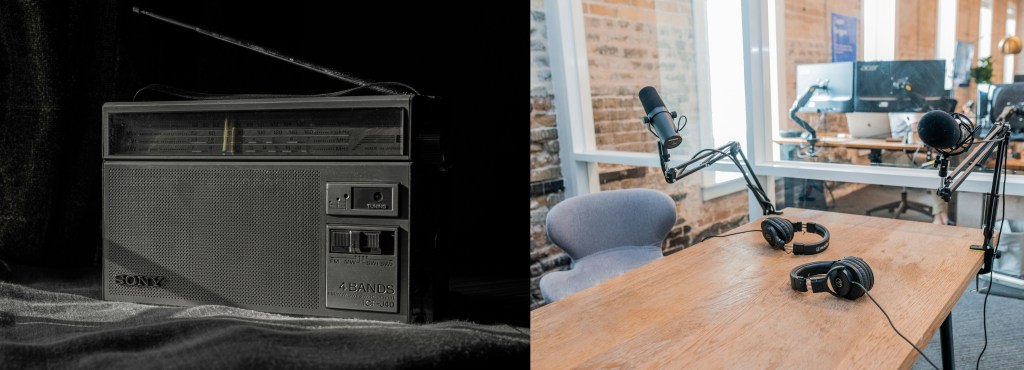
    “We all followed the cricket World Cup in 1983 only through radio commentary from the BBC. It didn’t matter that we couldn’t witness the moment with our own eyes—the emotions would’ve been the same.”


    That line—spoken by the host of a podcast I was listening to while crawling through Bangalore’s morning traffic—stayed with me.

    Today, I live in a world of endless streaming subscriptions and curated highlight reels. To imagine a time when people experienced something as iconic as India’s first World Cup win purely through radio feels almost… prehistoric.

    And yet, that comment made me pause.

    Did the absence of visuals make people listen more deeply? Did it help them imagine the moment in their own way?

    In many ways, radio was never just a medium—it was a companion. It spoke to you while you cooked, studied, commuted. It gave your mind space to wander, to create. You didn’t see the story. You felt it.

    Today, our brains are drowning in stimuli. Every screen, every swipe, every feed clamours for attention. We’re overloaded, constantly reacting, rarely reflecting. And the speed and scale of it all makes it harder to assess what’s true—contributing to a troubling rise in misinformation and mental fatigue.

    During the pandemic, this overload only intensified. But it also revealed something important: a desire for slower, quieter content.

    Enter: podcasts.

    They’re not new, but their resurgence feels like a collective exhale. The Indian podcast market alone is projected to reach $2.6 billion by 2030. And it’s not just growth—it’s a shift. Podcasts are being embraced not just for convenience, but for their texture—the depth, intimacy, and focus they offer by stripping away the visual.

    Podcasts echo the spirit of radio, but with on-demand flexibility and a diversity of voices and formats. They let you listen without being watched. They let your mind do some of the storytelling.

    And here’s where a beautiful phenomenon comes in—anemoia: nostalgia for a time you never lived through.


    For Gen Z or late millennials, listening to a podcast can feel like stepping into a world their parents or grandparents inhabited. A world where you absorbed news not through pop-ups or notifications, but through slow, spoken words.

    Ironically, we access podcasts through the very screens we’re trying to escape. But maybe that’s the point—they offer a mindful pause within our digital lives. They don’t shout. They don’t demand. They simply speak—and trust you to listen.

    And maybe that’s what mindfulness looks like today. Not always meditating in silence.
    But choosing to slow down.
    To listen deeply.
    To let a voice keep you company while your mind—finally—has room to breathe.