Tag: life

  • What Spotify Wrapped Knows About You That Your Instagram Doesn’t

    What Spotify Wrapped Knows About You That Your Instagram Doesn’t

    It’s that time of the year when my calendar nudges me to reflect on where the year went and when every service, website, and app I use serves up its annual Wrapped summary.

    My Spotify Wrapped, in particular, threw up an unexpected insight. It told me my listening age was 28 (apparently my listening personality is under pressure to get married) and that two of my top three artists belonged to the Deep & Progressive House genre.

    This came as a pleasant surprise.

    Growing up, I lived and breathed classic rock and metal and was one of those snooty people who looked down upon electronic music. For that version of me to now have electronic music dominate my listening felt like a shift I never consciously noticed.

    (P.S. Metallica has valiantly kept the metal side of my personality alive.)

    Even people who know me well associate me strongly with classic rock. An electronic music artist featuring in my top three would genuinely surprise them. And that got me thinking about the growing gap between our external and internal personalities in a hyper-connected world.

    Our external personalities shape how we are perceived – our behaviours, actions, and the motivations people ascribe to us. In 1919, Swiss psychologist Carl Jung described recurring patterns underlying human behaviour, which he called archetypes. He identified twelve such archetypes – Creator, Hero, Explorer, Jester, Everyman, and others – that transcend time and culture.

    Brands have long used archetypes to build meaning and emotional connection. Apple is often seen as the Creator, championing originality and innovation, while Nike embodies the Hero, motivating people to push their limits.

    But in today’s socially networked world, archetypes are no longer limited to brands. People, too, have begun to unconsciously adopt and project different archetypes across social contexts.

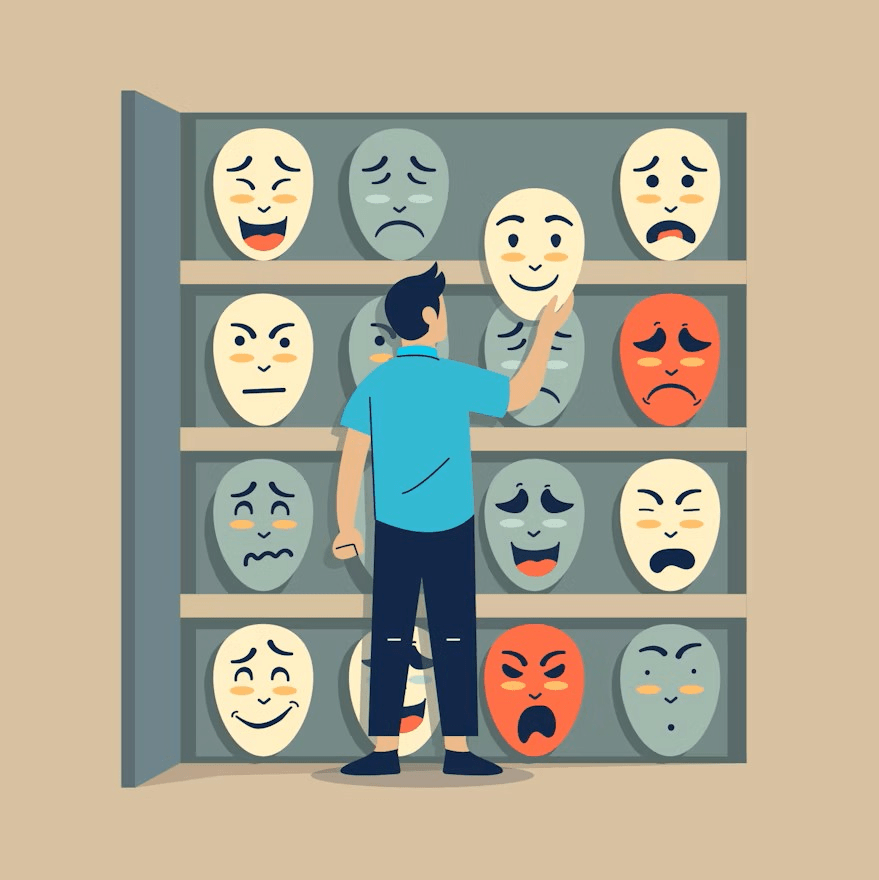
    I don’t behave the same way with friends as I do with my parents, colleagues, or on a date. Earlier, our social worlds were limited – family, school, a close circle of friends. Today, we move fluidly across many micro-contexts, each inviting a different version of ourselves.

    We might project the Explorer – non-conformist, interesting, adventurous – on a date, while being far closer to the Everyman in our everyday lives. These shifts don’t define who we are; they reveal the situational nature of human behaviour.

    Brands have captured this insight brilliantly in popular culture:

    It’s a familiar truth: what people say and what they actually do often diverge.

    The archetypes we project in social settings are largely System-2 behaviours—conscious, rationalised, and shaped by how we want to be seen. Our private consumption patterns, on the other hand, are closer to System-1 behaviour—habitual, unfiltered, and less performative.

    Reports like Spotify Wrapped are powerful precisely because they reveal this behavioural residue. They unearth patterns that feel closer to our core motivations than the identities we consciously curate.

    In a world where behaviour shifts constantly with context, brands seeking deeper relationships must look beyond projected personas. Understanding consumers today requires seeing both:

    • who they perform as (System 2)
    • and who they repeatedly behave like when no one is watching (System 1)

    Because meaningful, long-lasting relationships are built not just on who consumers say they are—but on who their behaviour quietly reveals them to be.

  • Staying behind to stay ahead

    Staying behind to stay ahead

    “Dude, Taylor Swift just got engaged. Didn’t you read about it?”
    “Did you see the Prime Minister’s US visit coverage?”
    “I can’t believe that actor said that. It’s so wrong.”

    Conversations like these are increasingly familiar. In today’s hyper-connected world, social status isn’t just about wealth or lifestyle — it’s also about being up to date. Knowledge has become social currency.

    For years, I felt that pressure. If I wasn’t the one offering the latest update, my “social creds” in a group seemed at risk. So, I scrolled endlessly — YouTube, X, WhatsApp, breaking news alerts. What looked like “staying informed” was actually doomscrolling: watching traumatic events unfold in real time, narrated with flashing graphics, dramatic soundtracks, and shouting anchors.

    It took a toll. The overload left me anxious, distracted, and less patient in everyday life. The breaking point came during a heated WhatsApp debate, when I realized my arguments weren’t even mine. They were recycled from videos and feeds. Somewhere along the way, I had stopped thinking for myself.

    From Information to Narratives

    News consumption has changed profoundly. A 2025 Reuters Institute report found that 55% of Indians now get their news from YouTube and 46% from WhatsApp. That means most people don’t encounter information first-hand — they absorb narratives pre-packaged with opinions.

    Contrast this with the old world of newspapers or Doordarshan bulletins. The news was slower. Headlines told you what happened, not what to think. Readers had to reflect and interpret. That act of independent analysis, small as it seemed, kept our minds sharper. Neuroscience calls this neuroplasticity — the brain’s ability to rewire and strengthen itself.

    Today’s feeds don’t give us that space. They reward reactivity, not reflection. The cost isn’t just misinformation — it’s the erosion of our cognitive independence.

    Strategic Ignorance as Self-Preservation

    My response has been what has been called strategic ignorance. I did not chase real-time updates. I read the news, but in print. That meant I’m often late to social conversations, but it also meant I reclaimed something more valuable — clarity, focus, and the freedom to form my own opinions.

    Strategic ignorance doesn’t mean being uninformed. It means being intentional about how information enters your life. It’s a way of protecting mental health in an age of information overload.

    The Larger Culture of Impatience

    This isn’t only about news. It reflects a wider cultural drift toward impatience and instant gratification.

    • Quick commerce delivers groceries in 10 minutes.
    • Social media offers instant validation in likes and views.
    • Even problem-solving has been outsourced to Google and AI before we wrestle with it ourselves.

    Anupam Mittal, founder of Shaadi.com, has warned that India risks raising “overstimulated, under-inspired digital addicts” — kids who don’t play, teens who don’t talk, adults who don’t think.

    The problem isn’t just distraction; it’s the erosion of effort. Small struggles — walking to the store, cooking a meal, puzzling through a problem — once built patience and empathy. Without them, we weaken our ability to think deeply and care broadly. And without new neural pathways, we risk becoming a society that reacts without reflection.

    Michael Easter puts it well in The Comfort Crisis:
    “As we experience fewer problems, we don’t become more satisfied. We just lower our threshold for what we consider a problem.”

    Choosing Slowness

    For me, the daily newspaper has become more than a source of information. It is an act of resistance. By slowing down, I remind myself that not everything worthwhile must arrive instantly.

    Yes, I may be late to the conversation about the latest celebrity engagement or political controversy. But in exchange, I get something much rarer: the space to think independently, protect my mental health, and preserve my brain’s long-term resilience.

    Sometimes, being a little behind is the only way to stay truly ahead.